« 18 October 2026 »: The official announcement of a new dramaturgy in the presentation of vietnamese art
On 18 October 2026, Vietnam’s most important newspaper, Báo Điện tử Chính phủ, published an article entitled:
“Gìn giữ, giới thiệu di sản mỹ thuật Việt Nam trên trường quốc tế” (“Preserving and introducing Vietnam’s artistic heritage on the international stage.”)
Three days later, the article was solemnly reproduced, word for word, on the website of Vietnam’s Ministry of Foreign Affairs:
It gives an exhaustive account of an exhibition, “Echoes of Tonkin,” devoted to the art of Vietnam and held at the prestigious Pascal de Sarthe gallery in Hong Kong, from 10 October to 21 November 2026.
Its two curators are Leah Do and Trần Đình Thục Đoan, two Vietnamese women in their thirties. I provided the scholarly guidance and wrote the preface to the catalogue.
The newspaper’s laudatory text enlightens the reader as to the exhibition’s purpose, discusses the sixteen works on display (though not for sale), and elegantly names the protagonists of the project.
The newspaper might have left matters there: contenting itself, quite rightly, with celebrating the preservation and promotion of Vietnamese art on the international stage; saluting the two Vietnamese curators (modern, and less tragic, Trưng Sisters…), who bear intellectual responsibility for this remarkable exhibition; and appreciating the “conquest”—admittedly entirely cultural, temporary and partial—of a corner of the Chinese cultural sphere.
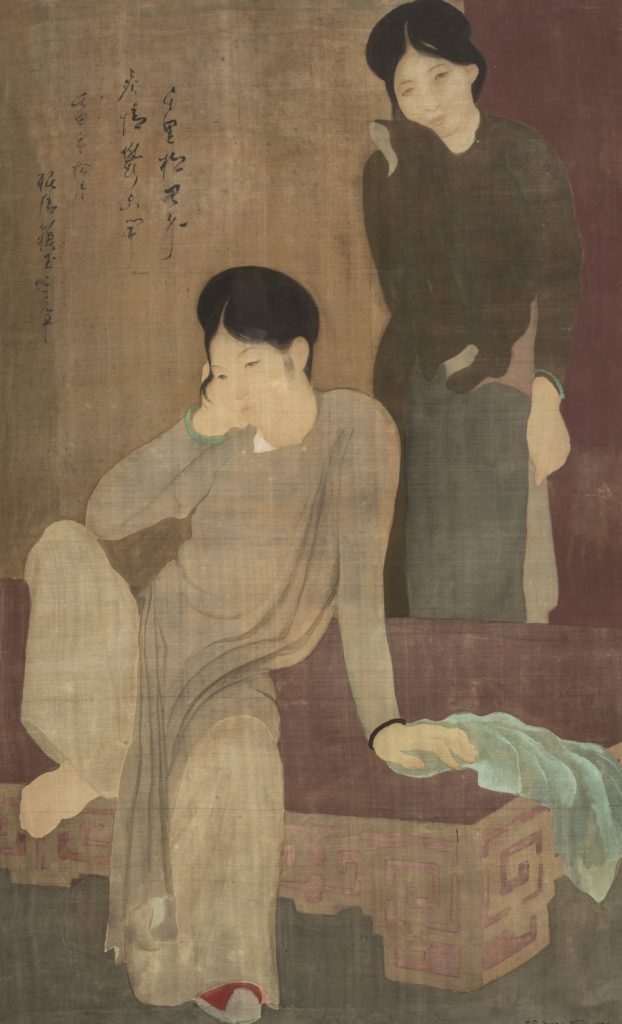
Contenting itself with a well-deserved satisfaction.
But the article ventures much further, raising itself (for the discerning observer) to the status of an official Manifesto: a new dramaturgy is proposed to us, founded on a constructed narrative, firmly anchored in its time.
With an addition, unprecedented and forceful, that formalizes a deliberate, regenerative turning point in the official presentation of Vietnamese art.
And here, the proposition becomes a recommendation.
Before setting out and commenting on this addition, it is worth introducing Báo Điện tử Chính phủ and establishing the fundamental extent of its influence.
Báo Điện tử Chính phủ (“Vietnamese Government Newspaper”) is an official press organ, established and launched on 10 January 2006. Integrated into the Vietnamese government’s information and communications system, it occupies a particular place in the country’s media landscape.
Its mission is to disseminate authoritative official information concerning the activities of the government and the Prime Minister, national policies and the country’s major strategic directions.
Beyond its mission of reporting on public policy and current affairs, Báo Điện tử Chính phủ also helps to shape the official media discourse on diplomacy, culture and national heritage.
Its authority and influence derive above all from its institutional status, the official character of the information it publishes, and its role within the national communications apparatus.
And it is this newspaper, the official voice of the Vietnamese state, that adds:
“Ông Jean-Francois Hubert, một chuyên gia cấp cao có nhiều đóng góp trong lĩnh vực nghiên cứu mỹ thuật Việt Nam, cũng đã đóng góp quan trọng về mặt học thuật cho Triển lãm và viết lời tựa cho catalogue.”
(“Mr Jean-François Hubert, an eminent expert of the highest standing whose intellectual contributions have considerably advanced scholarship and research on Vietnamese art, also made a substantial scholarly contribution to the exhibition and wrote the preface to the catalogue.”)
Of course, at first I might simply rejoice in this consecration, written without equivocation, openly proclaimed. An official Vietnamese declaration validating the commitment and labour of an entire lifetime. I naturally appreciate the honour of this tribute paid to me through the voice of the Vietnamese state.
But my quest, unrelenting for a number of decades I no longer dare to count, compels me to look beyond my modest person and place this fundamental article within a broader logic: that of a new communications policy by the Vietnamese state regarding the ancient and modern history of Vietnamese art.
For any attentive observer of the Vietnamese scene, everything suggests that this belongs to an impeccably conceived official undertaking.
Announced upstream, amplified downstream.
Upstream.
A new mantra begins to take shape and find expression on Facebook from March 2026. Four chapters (to date) are published: striking, sometimes harsh, but nourished by irrefutable observations and revelations, and directed against a close-knit band of pernicious influencers.
Although all had already been identified, this is the first time they have been subjected to such denunciation in Vietnam itself. And the first time, evidently, that the harmfulness of their compromises within the national cultural sphere is being recognized there.
What immediately strikes the reader, beyond the already mentioned vigour of the argument, is the almost literary quality of the writing of its signatory, Trần Hoàn Ca. No one knew him before his explosive intervention, yet one inevitably suspects a mature and erudite personality. And also—perhaps above all—an exceptional command of intelligence and a sense of combat that raise questions. Who can have access to such information? Who can conduct work of such almost surgical precision, carry out an undertaking that presupposes archival research, knowledge of foreign languages, mastery of networks?
The answer may lie in the question…
Named individually, their misdeeds denounced, the parasites thus targeted and identified have since changed their tune, markedly and swiftly. But one may suppose that the smokescreen behind which they conceal themselves will prove inadequate, as will the voyeurism that has sustained them. For the Vietnamese state will know how to punish what Raymond Aron already deplored in “Democracy and Totalitarianism” in 1965, namely: “Ignorance and stupidity (which) are considerable factors in History.”
To remove the dross is one step; to recall the founding principles is another.
Downstream.
For combating ignorance and stupidity is not enough. And if one needed persuading of the official determination now at work behind a new dramaturgy, one need only turn to the very recent statements on culture and diversification by the Party’s General Secretary and President of the Republic, Tô Lâm.
On 5 November 2026, he called for the preservation of cultural heritage and for stronger solidarity among communities during the celebrations of the 2026 National Great Unity Day and Vietnamese Culture Day, held in Da Lôc hamlet, Châu Thành commune, Vĩnh Long province, in the South. The choice of location is obviously subtle, with its Khmer and Chinese communities.
There, Tô Lâm recalled that:
“At the first National Conference on Culture, exactly eighty years ago, President Hồ Chí Minh declared that ‘culture must light the way for the nation.’ He emphasized that solidarity was a fundamental value that had enabled the Vietnamese people to overcome adversity, while culture nurtured patriotism, a spirit of sharing and collective responsibility.”
He also stressed the need to: “enable everyone to know their origins better, to respect their own heritage as well as that of other communities, and to contribute to the preservation of shared values.”
“Culture,” “nation,” “patriotism,” “origins”: powerful words, yet concepts that are… universal. And without imposed meaning…
To be sure, in matters of “socialist realism,” Vietnam did not have to endure, for instance, the (Soviet) torments of Andrei Zhdanov’s report of 14 August 1946, even if the debate was fierce, notably in 1955–56.
It is clear that in Vietnam this “socialist realism” belongs more to historical reference (the “War of Liberation”) than to actual practice, for here too the supremacy of political imperatives failed to eclipse aesthetic concern.
I have always defended this position, and the market, virtually alone, has succeeded in vindicating my view.
“Echoes of Tonkin” deserves to be saluted for having subtly provided the culminating flourish to a considered undertaking, poised between a warning shot and a joyful aspiration. A chronology openly embraced. The choice of two Cham stone sculptures, Hindu and Buddhist (they might equally have been, among a few other possibilities, two Funan statues or a jewel from Óc Eo), which I compare in my catalogue preface to “two peonies in a bouquet of roses,” in the hope that the initiated reader knows that the union of peony and rose conveys a powerful message of continuity, harmony and enduring prosperity.
In 1949, Tô Ngọc Vân (whose 1932 gouache and ink on silk, “The Disillusioned Women,” 92 × 57 cm, I have placed at the beginning of this article), in an essay (“Should One Study or Not?”), had denied the masses the right to criticize artists, since they lacked the necessary qualifications for want of study… Nguyễn Đình Thi (1924–2003) opposed him in a major debate in Việt Bắc, on 25–28 September 1949; and the hard, exclusionary, dogmatic line prevailed under the banner of Tố Hữu (1920–2002).
Does the new dramaturgy of 2026 signal a new “Đổi mới” (renewal), forty years on—this time specifically for Vietnamese art?
Only the near future will tell.
Jean-François Hubert