Trần Nguyên Đán, 2008-2009, or the structured target of memory
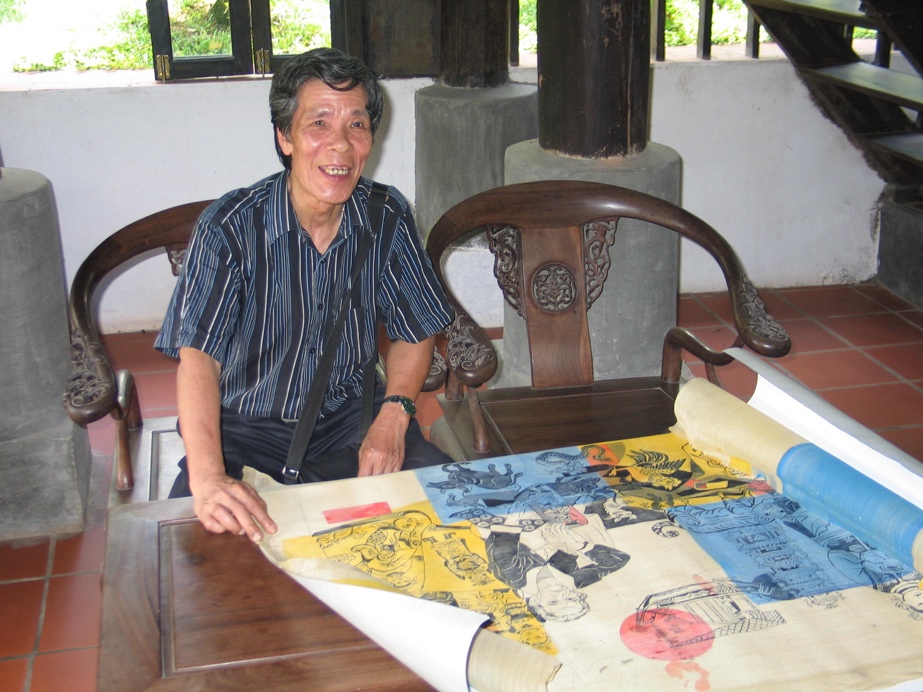
For Trần Nguyên Đán, born in 1941, a graduate of the Hanoi University of Fine Arts and former deputy director of the Vietnam Fine Arts Museum, woodcut—a medium that allows for neither hesitation nor second-guessing—forms the foundation of his artistic practice.
This is rooted in the physical act of engraving, where each incision determines both form and boundary. From this constraint emerges a language of remarkable clarity. While one can detect distant echoes of the Đông Hồ and Hàng Trống traditions, these are not mere references, but rather a continuity, absorbed and rearticulated within a modern pictorial order. His compositions are often structured through accumulation rather than perspective, where figures, motifs, and architectural fragments coexist in a measured, flattened space.
Trần Nguyên Đán has mastered the printing technique and the separation of contrasting colors in line drawings and shapes that are sometimes extremely complex and sophisticated. By finishing his work “by hand,” he creates an additional, strange, and ethereal beauty without distorting the original.
But his exploration of the vernacular is neither idealized nor oversimplified.
Rural life, rituals, and landscapes do not appear as mere anecdotes, but as enduring forms, maintained within a rigorous visual balance. Thus, his work does not merely document cultural memory; it perpetuates it.
Both works offer a rare combination of vision and structure, reflecting Trần Nguyên Đán’s enduring commitment to Hué. He approaches the location with rigorous line work and a structured approach to memory, in which observation is inseparable from composition.
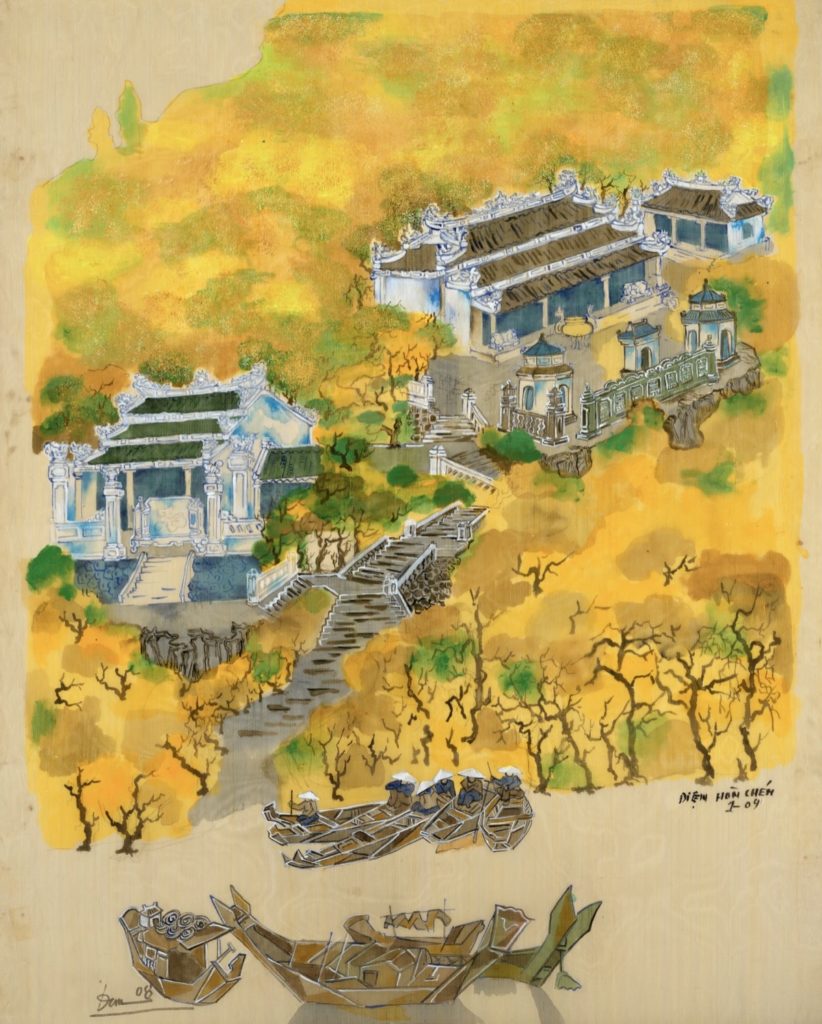
“Hòn Chén Temple”
Mixed media
96 x 77,5 cms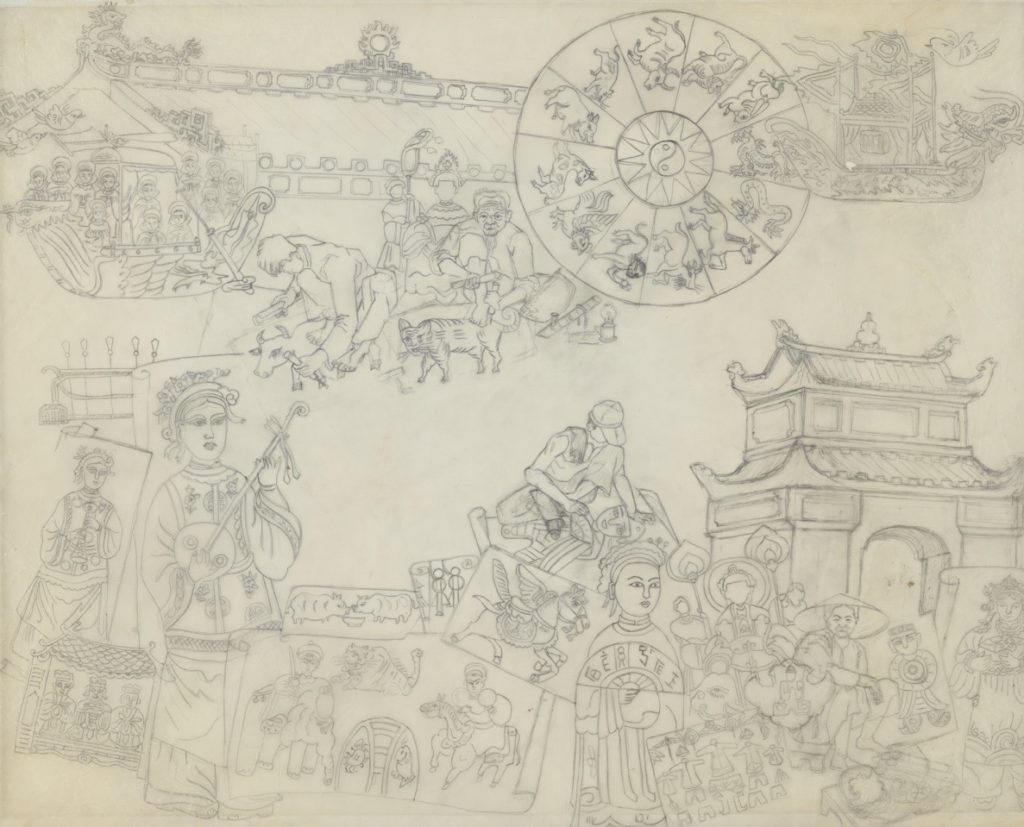
“Sinh Village in Hué”
pencil on tracing papers
76 X 97,7 cms
Created in 2009, “The Hòn Chén Temple” evokes one of Hué’s most striking sacred sites.
The artist does not merely depict it in architectural terms but allows it to emerge from a field of ochre and moss green. Its terraces unfold in a measured ascent, guiding the eye along a peaceful, almost ritualistic path. The use of gouache on silk preserves the clarity of the graphic concept: the contours remain firm, while the color is contained within controlled planes. The image seems suspended between presence and memory. It is less a view than a distilled impression, shaped by time.
The pencil drawing on tracing paper, “Village of Sinh in Hué,” created in 2008, brings together a dense array of ceremonial motifs and figures, scenes of labor, architectural fragments, and the zodiac cycle—all within a flat, simultaneous space.
This principle of coexistence, central to the artist’s works dedicated to Hué, reflects a mode of perception in which temporal and cultural layers are not separated but kept in balance.
Both works combine a process of accumulation with one of condensation.
The drawing brings together a cultural vocabulary; the painting refines it into a composed, contemplative form : Hué, a place the artist adores despite being originally from Bac Ninh in the north, is not static, but a structured memory sustained by the artist’s skill, reflection and persistent gaze.
Jean-François Hubert