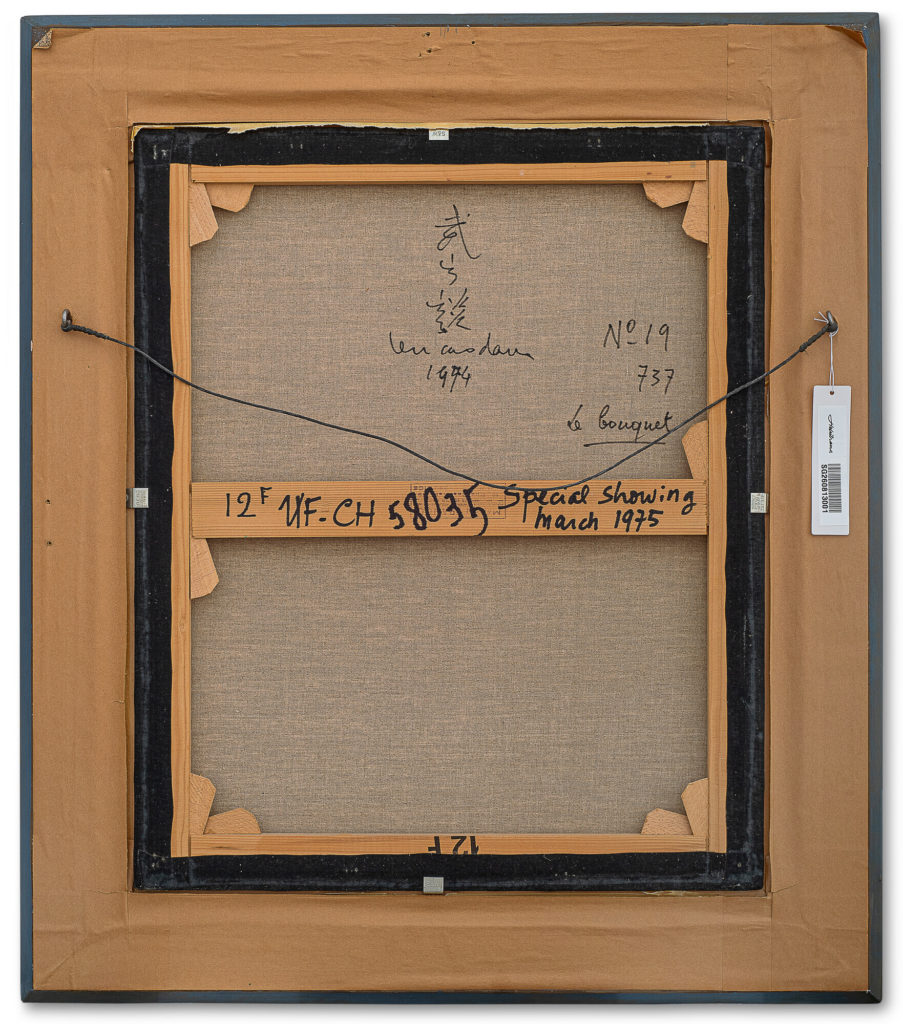
Vu Cao Dam, « Le Bouquet » (The Bouquet), 1974
Vũ Cao Đam was a scholar with a deep interest in both Eastern and Western cultures, a passionate and elegant advocate of their arts, from which he drew inspiration—sometimes from one to the other, and often simultaneously.
In the French art world, he regarded Picasso, Matisse, Braque, and Chagall as masters (just as much as the great Italian masters he admired…).
The artistic power and pacifist convictions of the first, the artistic expression that served the simplicity of the spiritual in the second, and the active exploration of materials by the third: Vũ Cao Đam knew how to draw inspiration for his art from these magical sources.
But the strongest contemporary influence, as evidenced by “Le Bouquet,” was that of Chagall. As early as 1948, the Belarusian Jewish artist’s pictorial world captivated the Vietnamese Catholic. It is a little-known fact that Le Pho shared this fascination.
One might think that it draws primarily on a shared sense of exile. However, for neither of them was this a forced situation, but rather a chosen one — even a self-proclaimed one.
But it was also made easier because the two artists were neighbors and interacted freely in Vence, where Vũ Cao Đam and his family lived in the villa “Les Heures Claires” (Bright hours) right next to the Matisse Chapel between 1952 and 1958, before moving to Saint-Paul-de-Vence, at 40 Rue Grande—and later, not far from there… Chagall.
In our 1974 painting—which was therefore painted in “Saint-Paul”—Vũ Cao Đam depicts a young man and woman in a space almost entirely filled with blue.
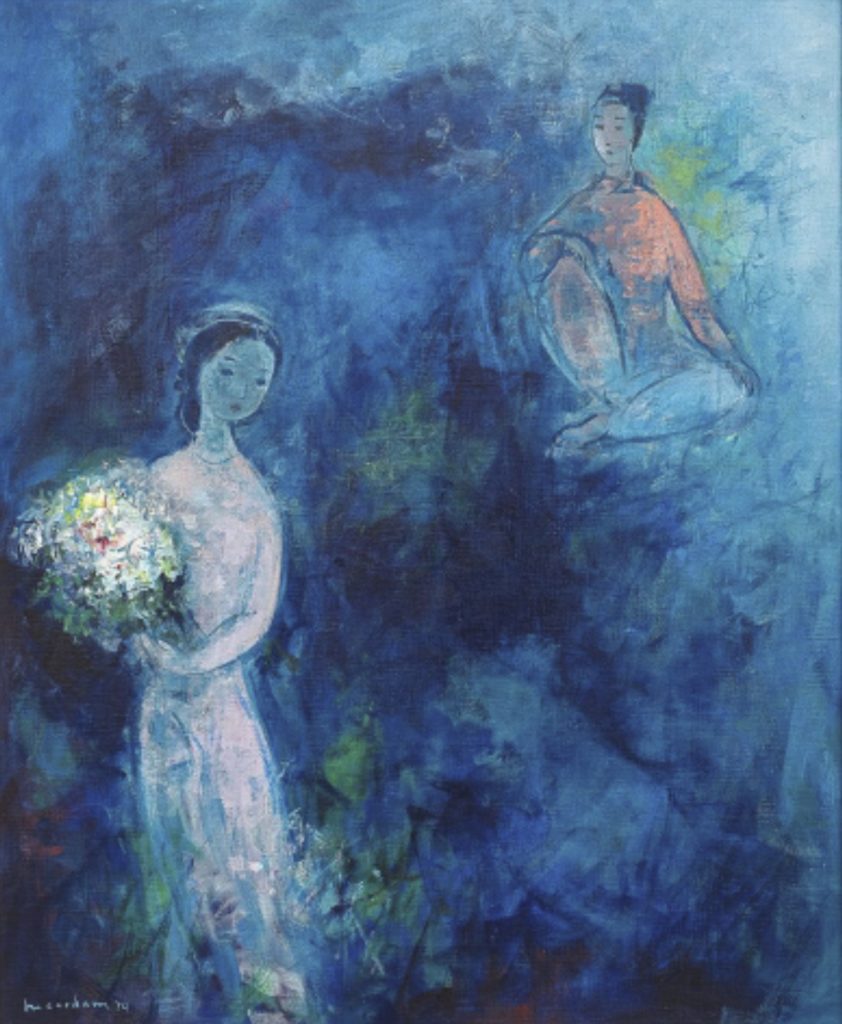
The composition is organised along a diagonal: a standing figure in the foreground is mirrored by a second figure, seated and slightly raised to the right.
The physical distance between them creates more of a silent dialogue between two presences than a narrative scene.
The young woman in the foreground is wearing a very light-coloured ao dai and holding a lush bouquet of white flowers. This serves as the main source of light in the work.
By contrast, the seated man is wearing white trousers and a reddish-orange tunic, which adds a warm touch and balances the cold vastness of the blues.
The figures are barely sketched and seem to dissolve into the landscape, while the faces are rendered delicately and remain almost motionless.
The background does not depict any specific place: blue, turquoise, and touches of green blend together to form a vibrant composition, somewhere between a garden, mist, and abstraction.
This dissolution of space is characteristic of Vũ Cao Đam’s later paintings, in which blue becomes a veritable atmosphere enveloping the figures.
The free brushwork and Western painterly style thus coexist with the linear elegance and poetic restraint inherited from his Vietnamese culture.
The work as a whole evokes a contemplative and almost dreamlike vision, in which humans and flowers appear less like figures in a real setting and more like they are suspended in a memory. We will refrain from overemphasising the allusion to Kim Vân Kiêu, which nevertheless remained in the memory of the artist, Vũ Cao Đam, throughout his life.
Let’s return to Chagall’s influence, which has been mentioned so often. Let’s identify what is and isn’t true about it.
For example, one can draw a parallel between “Le bouquet” and an earlier work by Chagall
created between 1958 and 1960, “Les amoureux de Saint-Paul de Vence,” thereby making use of the three unities of time, place, and action advocated by 17th-century classical French theater.
Through hues that shimmer like precious stones, Chagall transforms the undulating foliage of a tree on the right into a bouquet of flowers. In this ascent toward the heavens, a play of hues blending pinks, reds, yellows, and vibrant greens envelops a solitary shepherd accompanied by one of his sheep. Employing his signature narrative style and exceptional chromatic luminosity, Chagall brings to life the joyful abundance of love at the heart of French nature.
Painted at night and bathed in deep blues under the moonlight, the work celebrates the natural, untamed beauty of the village of Vence. One is immediately reminded of the artist’s early masterpieces, such as “Bella Rosenfeld”—his first wife, muse, and great love—or, in “Above the City“, the couple reclining above Paris in “The Bridges of the Seine”. Here, Chagall uses the symbol of couples levitating above urban landscapes to convey a range of intertwined emotions. Evoking a happiness that is self-sufficient, transcendence, and a deep attachment to the region, “The Lovers of Saint-Paul-de-Vence” stands as a tribute to love in its most universal sense: a true sonnet celebrating the fundamental emotions of the human experience.
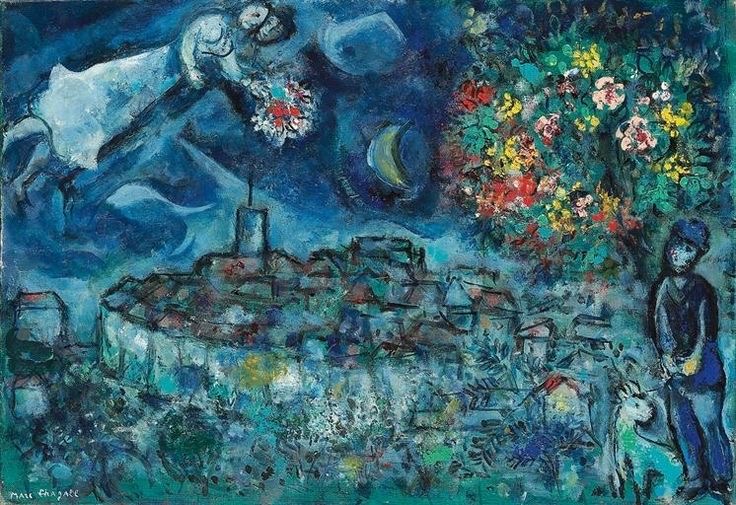
Therefore, while colour and composition bring the two artists together, it is understandable that they may appear to be a mere illusion.
Admittedly, the similarities are evident from the outset:
On the one hand, the color blue, in its various shades, serves as a structuring element that defines space for each artist.
On the other hand, the significance of flowers (which Vũ Cao Đam also reflects in his choice of title), even though the two artists treat them differently.
Finally, the psychology of the characters. Distant, face to face. Posing. Key players in a scene of memory.
But there are clear differences.
Chagall offers a more intimate, vertical composition and sets his scene within a recognizable urban landscape—Vence—while Vũ Cao Đam’s work is more dreamlike.
Chagall focuses on the group, the city, and the two couples. Vũ Cao Đam focuses on the distant couple and the ethereal void. Accumulation for one, emptiness-fullness for the other. Saturation versus detachment.
Two styles that are sometimes similar, yet two different worldviews.
And a dialogue between two masters that we take pleasure in listening to.
Jean-François Hubert