Le Pho and religion, or deferred feelings
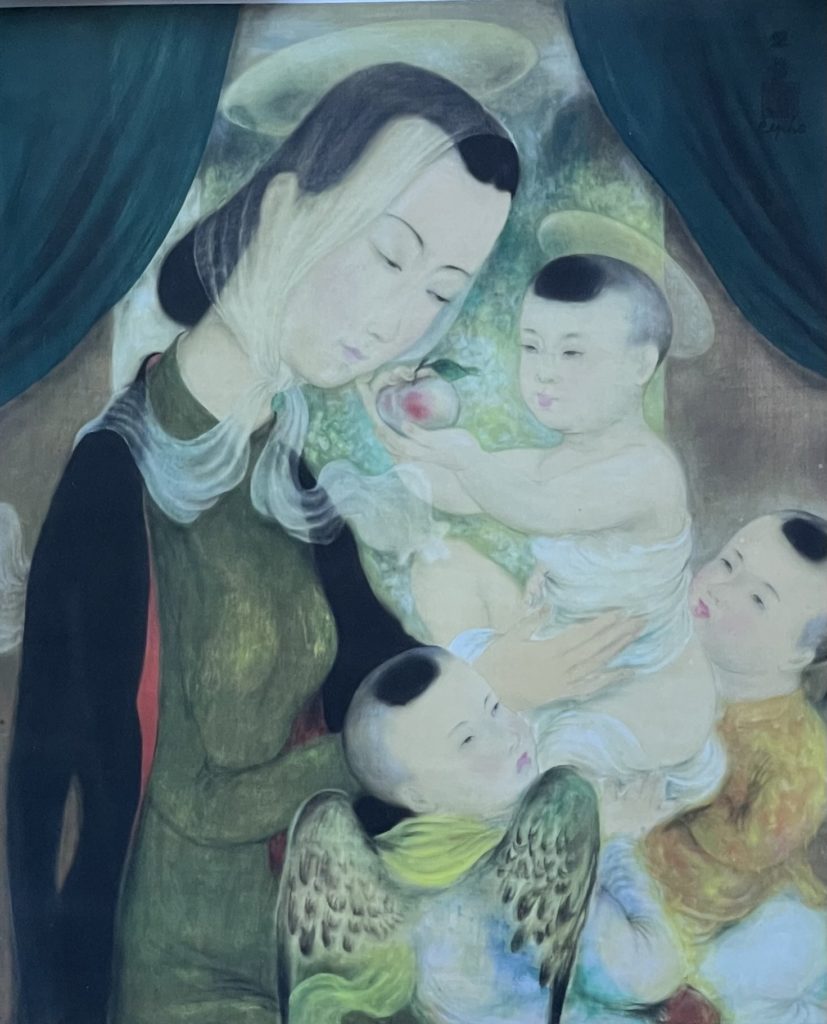
Vierge à l’Enfant
Gouache and ink on silk
55 x 46 cm
circa 1938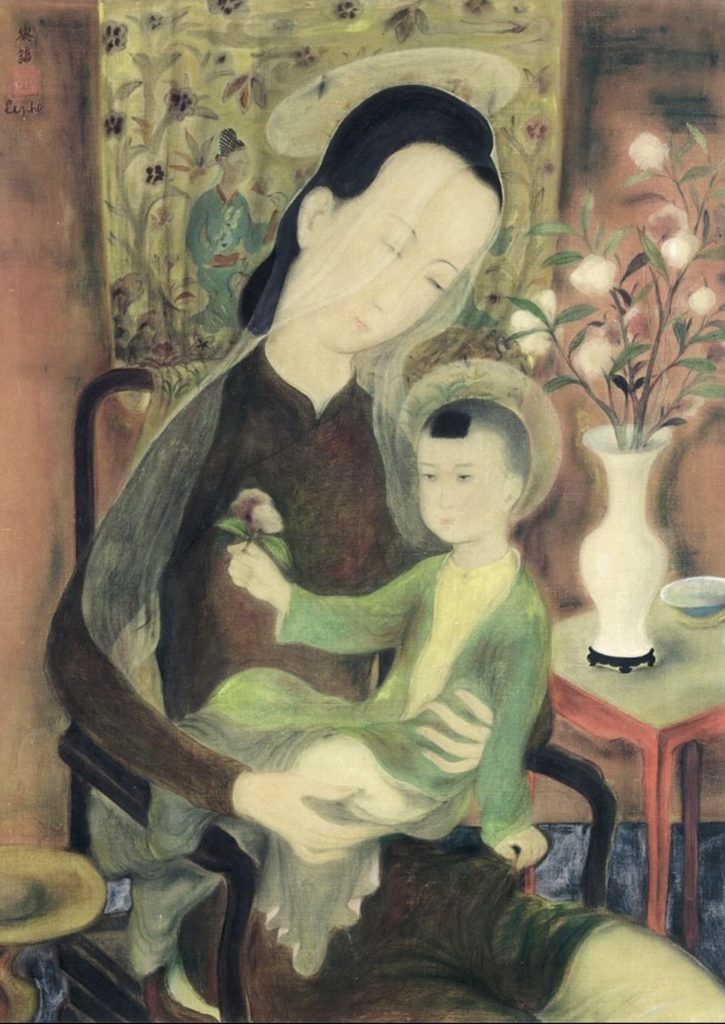
La Vierge Marie et l’Enfant Jésus
Gouache and ink on silk
72 x 52 cm
circa 1938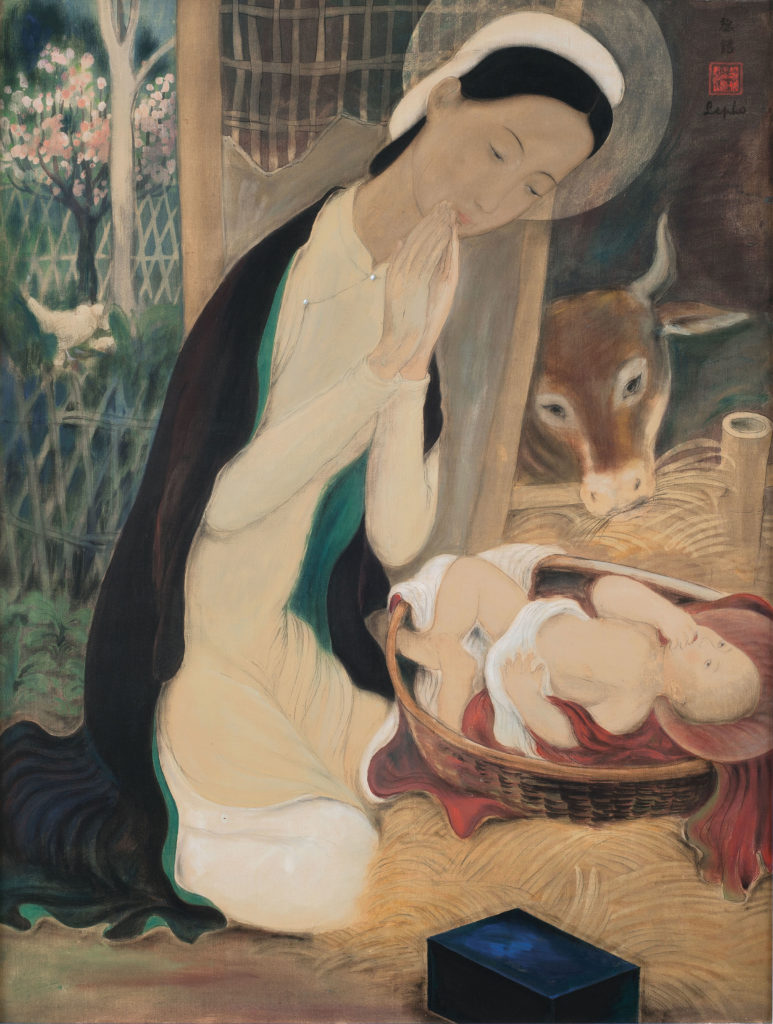
Nativité
Gouache and ink on silk
62,6 x 51,3 cm
1941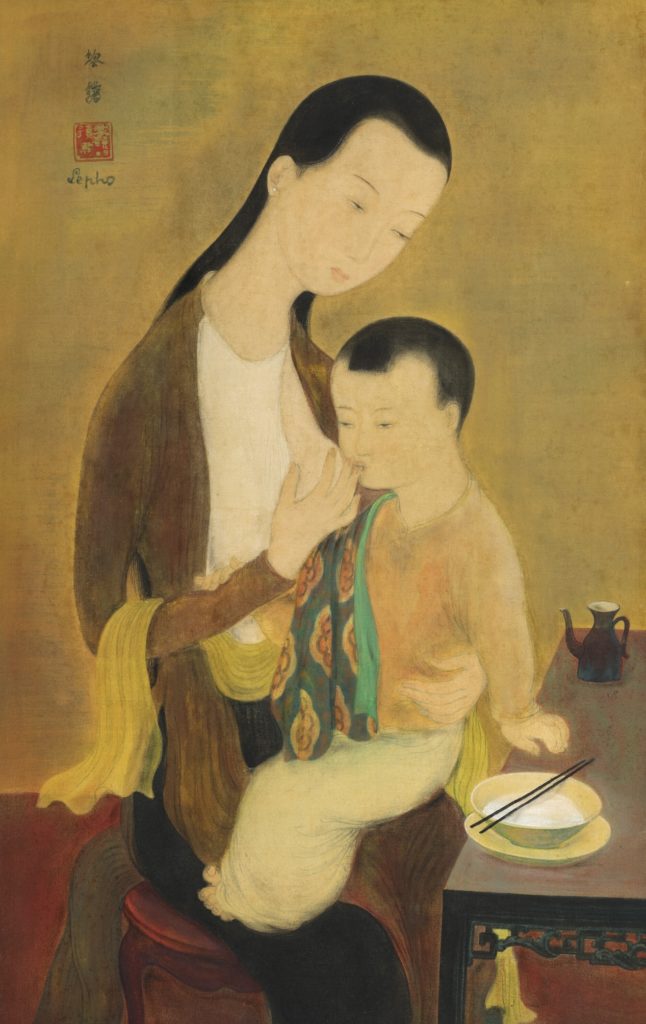
Maternité
Gouache and ink on silk
45 X 28,5 cm
vers 1938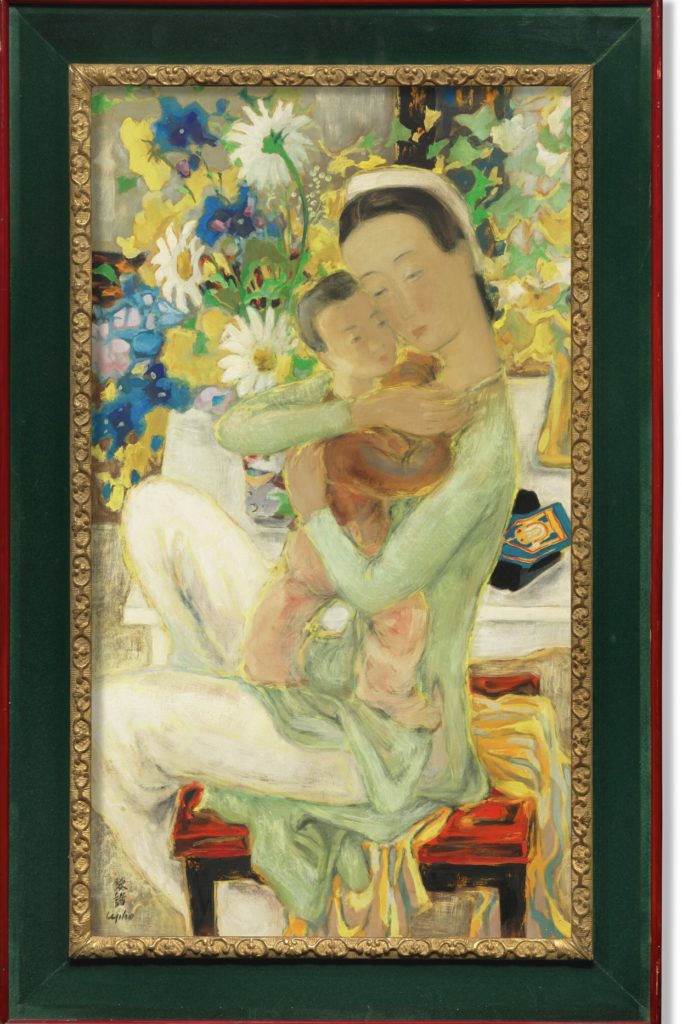
Maternité au Bouquet
Gouache and ink on silk
78 × 45 cm
Circa 1955
Le Pho claimed to have painted around 2,000 works during his lifetime. Spread over 65 years, if we limit his artistic life to his student years (1925–30) and his dramatic acciden t in 1990, which left him unable to paint.
Paintings that we classify – assuming arbitrariness – into the ‘Early Period’ (1925–1945), the ‘Romanet Period’ (1945–1963), and the ‘Findlay Period’ (1963–1990).
This has already been described at length.
On the other hand, the religious, specifically Catholic, connotations of the painter’s work have rarely been mentioned and are little recognised.
This might seem rational at first glance, as the inventory of his work – bearing in mind that future discoveries cannot be ruled out – includes few religious paintings. Essentially, there are several ‘Virgin Mary and Child Jesus’ paintings, all from around 1938-40, a “Nativity” and a ‘Descent from the Cross’, both from 1941.
This seems logical, too, because few elements of the painter’s personal profile – he came from a family of Tonkinese mandarins steeped in a diffuse syncretism of Confucianism, Taoism and Buddhism – objectively led him towards Christian sensibilities.
But let us distance ourselves from this presumed rationality and logic. Above all, let us be wary of supposed determinism.
For beyond the paintings that we will discuss later, it is important to recall here the long-standing Catholic influence in Vietnam.
Remember Alexandre de Rhodes (1591–1560), François Pallu (1626–1684), Pigneau de Béhaine (1741–1799), François-Marie Pellerin (1813–1862) and Paul-François Puginier (1835–1892), among many others. All were certainly conscious of their faith, but perhaps even more so, they were devoted to their host country.
Mention Catholic charitable or educational institutions that are greatly appreciated by the local population. Observe the local architecture, churches and cathedrals that have become icons of identity claimed by all over time. Also visit places of strong devotion, such as the Basilica of Lavang (the site was distinguished by the apparition of the Virgin Mary on 17 August 1798, a beautiful church built in 1901, enlarged in 1928, and severely damaged in 1972).
Much more than an influence. A widespread spirituality that Le Pho was inevitably confronted with in his youth.
But let us observe the works.
First, the three nuns: it is important to note the extreme iconographic discretion. Few details mark the Catholic identity. Certainly, the halo (for the Virgin Mary and Jesus) and the double flower of the child are present, as are the dove, the cherubs and the ox. But the three representations oscillate between quotation and allusion. A very minimal message.
Far removed, for example, from the symbolic complexity of Andrea Mantegna and his Adoration of the Shepherds (1451–1453)…
More broadly, throughout Le Pho’s work (again, subject to works discovered later), we see, in addition to the absence of Joseph, the non-representation of the cross, the fish, the anchor, and the chi-rho. This is a deliberate choice, for even his 1941 ‘Descent from the Cross’ shows us a lifeless Christ, his forehead beaded with blood, but without a crown of thorns.
Furthermore, let us not look for distinctions between red seraphim and luminous cherubim, or particular facial expressions – his Virgins and Jesus have the same – or references to biblical ‘clouds’ in the artist’s work. Nor is there any choice of red dress and blue cloak for Mary, or even blue and white (in the tradition of 19th-century France).
There is no Jesus as ‘Messiah of the Poor’. There is no tree with a single branch (representing his descent from David). There is no willow tree, no Calvary. These are all symbols that the painter has nevertheless identified in European painting.
For we must mention here a decisive journey, the one he made to Italy in 1932 (on the blog, here and there) and the immediate fascination with Renaissance painting that seized the artist there.
An immediate question arises: was Le Pho attracted to Italy and its art, or was he beginning or completing a religious journey? Here, of course, we are once again faced with the impossible choice between the signifier and the signified. Alain Le Kim, the painter’s son, (in an oral interview on 11/12/25) recalls his family’s trips to Italy ‘by car, 3/4 days’: ‘he took us to specific chapels to show us paintings he had seen there 30 years earlier’.
An Italian fascination complemented by admiration for other, non-Italian talents… such as Jean Fouquet, the Master of Moulins (Jean Hey), Hans Memling and Stefan Lochner.
And yet, behind his models, Le Pho offers us a representation as simple as a garment worn, but as moving as an incarnation. That of an apostle, not a theologian.
This message, ultimately, can be found in the two secular representations above.
We can see that even though the colours may have changed, the material surroundings are different and the halos have disappeared, the faces of the ‘woman’ and ‘child’ remain identical to those in religious representations. We can only observe a greater physical intimacy – the child suckling – and a more exuberant setting, with a bowl, chopsticks, a jug and… an abundance of flowers.
As if secular and religious were merging.
Who wins here?
The signifier or the signified?
We will never know…
But André Comte-Sponville once again comes to our aid:
‘The relationship between the signifier and the signified, which is arbitrary, remains internal to the sign; this is what distinguishes the signified from the referent and the meaning from the designation’ (Dictionnaire Philosophique, 3rd edition 2021, pp. 1204-1205).
As for us, here, let us simply say that Le Pho was baptised in 1990. He took the baptismal name Victor, that of his master, the painter Victor Tardieu, founder of the École des Beaux-Arts d’Indochine.
So, was it a feeling that came very early or was it just deferred?
It seems obvious…
Jean-François Hubert