Vietnamese painting must finally embrace its origins!
A direct result of the Indochina School of Fine Arts, which was founded in Hanoi on 27 October 1924, Vietnamese painting has played a significant role in all the key artistic debates of the 20th century. However, it does not currently receive the recognition it deserves.
The explanation could have been his young age.
A youth that may seem astonishing, given that there were no painting schools in Vietnam prior to the creation of the School. This astonishment is reinforced, on the one hand, by the contrasting example of neighbouring China with its ancient pictorial tradition and, on the other hand, by the country’s extraordinary and very ancient cultural wealth in other artistic fields (bronzes, ceramics, sculptures, etc.).
However, this argument cannot be accepted because other artistic movements that are just as recent have been the subject of numerous descriptions, commentaries and studies, both in the West and in Asia, for example.
Another argument may be its youth in terms of public exposure, rather than institutional creation. This was mainly achieved through the market and a few exhibitions. As I have mentioned countless times, Vietnamese painting wandered in a mental, political and psychological desert in the early 1990s. With a certain immodesty, I have recounted my part in this flowering.
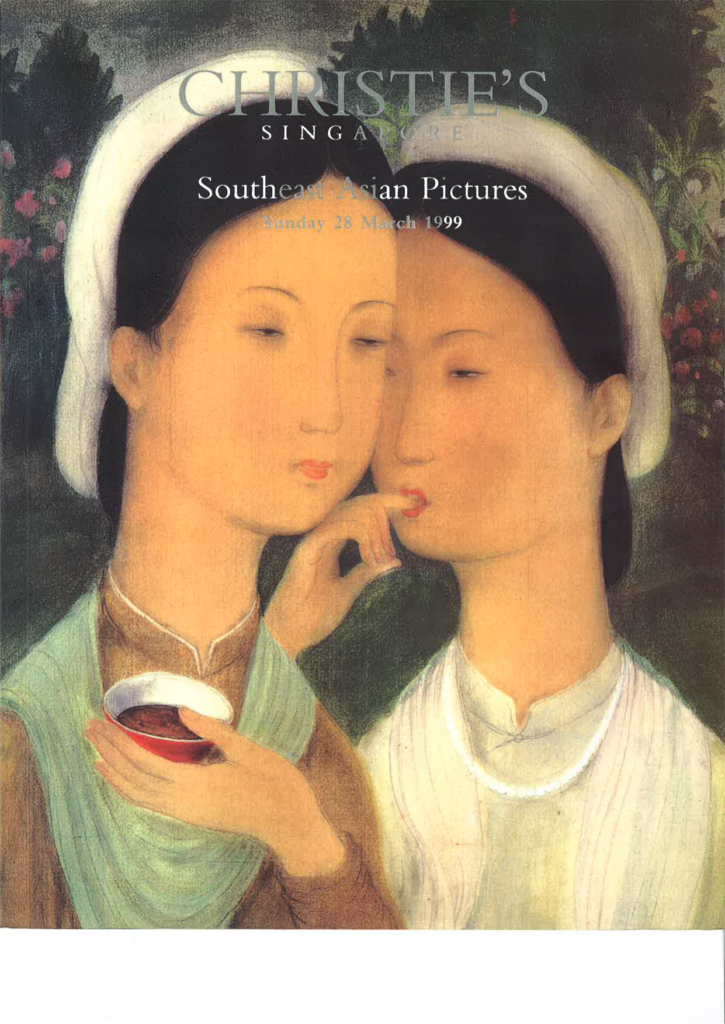
A certain flourishing began to emerge, for example, in the coverage of this sale (for which I was the expert) at Christie’s in Singapore on 28 March 1999. Le Pho’s beautiful gouache and ink painting (circa 1938), unearthed by a collector in Paris, had graced the cover of the catalogue and joined the collections of the Singapore Museum.
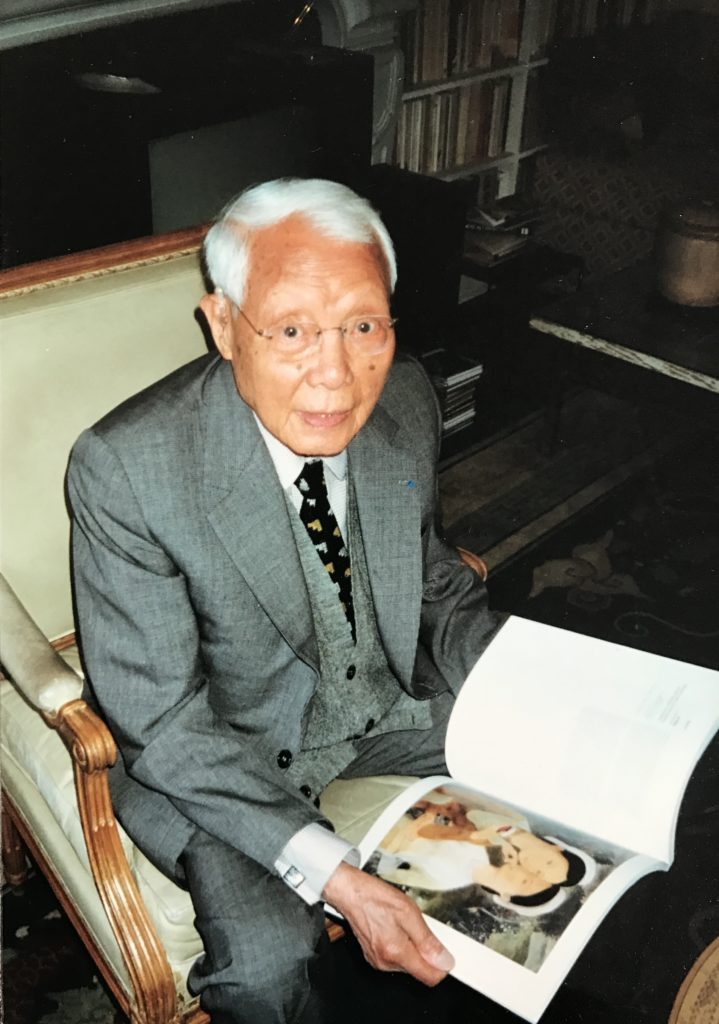
In the photograph below, we can see Le Pho’s face, his discreet but confident pride as he leafs through the copy of the catalogue I had just brought him—before the sale—at his home at 235 bis rue de Vaugirard in Paris. A sure sign that we were making history, I took this photograph without too much trepidation of a 92-year-old man who had regained his panache.
It was a time of passion, conquest and beauty. You have to love living art to understand.
Like all of Victor Tardieu and Joseph Inguimberty’s students, Le Pho knew that the sole source (the Indochina School of Fine Arts) of Vietnamese painting was a purely French colonial creation. He knew that it had benefited from assiduous promotion (exhibitions, publications, grants, etc.) by this same colonialism from 1925 to 1945, not only in Vietnam itself but also in France. Like all Vietnamese artists of his generation, he was aware that everything in what would later be called the ‘Hanoi School’ was a product of colonialism.
Not writing it down is an insult to history.
A colonialism of passionate men and women. Not French on one side and Vietnamese on the other, but here, side by side.
This assertion, I know – and Le Pho even more so, having been called a ‘sell-out’ by some Vietnamese – is not at all in keeping with the compulsive mood of the times. Neither in France, where historically, except for a minority, colonisation had generated little interest. Nor in Vietnam, where, except for another minority, it has generated active or passive rejection.
But what should be done with this ‘child painting’, abandoned by its father, France, and driven out of the family by its mother, Vietnam?
Few texts and few exhibitions have risen to the challenge, and Vietnamese painting remains the victim of soothing (post-colonial) clichés outside Vietnam and the malice of social media, a veritable social cesspool in Vietnam. All of this testifies to a widespread mental, political, social and cultural deficiency.
Everything therefore remains to be built.
But is this still possible?
How can we escape this self-satisfied cacophony, how can we escape the Western bourgeois bohemians and the Vietnamese lumpenproletariat and their supporters, whether individuals or institutions?
Through Horace’s ‘Sapere aude’ (‘dare to think for yourself’), Gassendi, Kant and the Enlightenment.
And to begin to ‘think for oneself’, to effectively address the cultural clash between France and Vietnam and Vietnamese painting, one must (the list is only indicative) know Alexandre de Rhodes, accompany Pigneau de Béhaine, talk with Nguyễn Du, desire Hồ Xuân Hương, take inventory with Parmentier, support Tardieu and die, alone, in the jungle.
Then one must let the works speak for themselves.
And let them tell us that, if the most sought-after works are those by painters who left Vietnam and/or challenged communism, the national doctrine today — from Lê Phổ to Nguyễn Gia Trí — if many of the finest painters lived and created longer in France than in Vietnam, and if the graduates of the École des Beaux-Arts all withered away in the absence of the French presence, then beyond an irrefutable aesthetic and historical fact, there lies an implacable moral truth.
One must accept that Danh Vo is Danish, not Vietnamese, that Jean Volang did not want to be a Vietnamese painter but an international one. And that one is noble when one is ennobled oneself. Only then.
One must also prefer consubstantiality to intersectionality. This will give us a better understanding of this painting, which we should then define as ‘so-called Vietnamese’.
One would then readily admit that every answer is merely a perverted question.
And ‘Vietnamese’ painting would be saved.
Jean-François Hubert