Nguyen Phan Chang, « La laveuse de légumes » (Washing Vegetables), 1931 or the simple purity of time standing still
“When I went out to paint at dawn, I usually walked along rivers and canals. One day, as I was passing by a jetty, I saw a young girl washing vegetables by the water’s edge; her white shirt and black trousers were barely visible in the morning mist. It was dreamlike and very beautiful. I have always loved misty, dreamlike and poetic scenes.”
In his diary, Nguyen Phan Chanh himself described the vision and feelings behind this beautiful and dignified work of art, created using gouache and ink on silk (63 x 50 cm), which bears witness to the painter’s art at its peak.
Here, everything is restrained. Not an absence, but an abstention. Like a desired mourning that is about to begin. True mourning, that of the absolute. The painter knows, and this is neither an extreme Eastern nor an extreme Western trait, that the world in which he was born is disappearing. He does not regret this because he feels it is perishable, like himself. But he wants to suspend it.
The time to lose it and paint it.
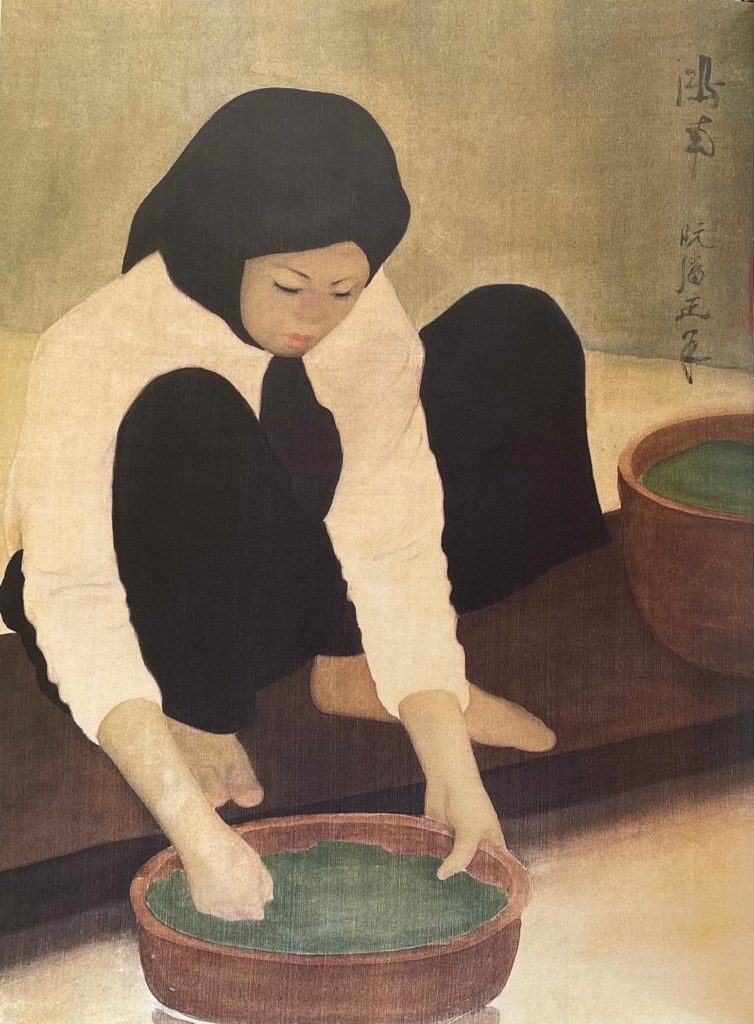
Honouring the memory of suspended time. In an almost geometric work.
Let us observe the triangle formed by the ink-black legs, thighs and headdress of the young woman. Three isolated black masses united by the cream colour of her blouse.
In addition to the triangular shape, there are two circles formed by the two basins: one for washing vegetables and the other for storing them. Note that the vegetables themselves are not visible, so for ‘reality’ we must take the title given to the work by Nguyen Phan Chanh himself.
Finally, follow the long, straight line rising from left to right, representing the pontoon supporting the young woman.
In the background, the horizon is obscured by the water and the mist that the painter evokes in his diary.
We are closer to Kandinsky in 1925 than to Le Pho, his classmate at the Hanoi School of Fine Arts, among others. There is no décor (decoration ?). All this could be limited to semi-abstraction if it weren’t for the realism of the young barefoot woman dipping her bare hands into the water.
The distinction between the nutrient and its guardian.
For Nguyen Phan Chanh, only the dynamic of the gesture, frank and useful, matters. In this work, there is no excess of calligraphy, just a signature. There is no accompanying poem or use of ideograms to support the representation.
Ideograms are read from right to left and from top to bottom:
辛
末
冬
之
畫
南鸿
鸿
南
阮
潘
正
筆
Hong Nam is the painter’s pseudonym, Nguyen Phan Chahn is his name, ‘painted by’, Xin Mò, Dong, Zhi, Hua, which can be translated as painted during the winter of 1931.
The colours, limited by the range of gouache, appear dull and ‘muddy’, as one critic later remarked.
It was the painter Lebadang (1915–2021) who put me on the trail of this legendary work. I had known about it for a long time, having seen it reproduced and published extensively — from the 1932 illustration to modern-day T-shirts in Vietnam. It was an icon, a marvel that I would finally be able to see with my own eyes.
Lebadang had a deep contempt for the Hanoi School of Fine Arts. This was probably because he was a crypto-communist, comfortably ensconced in French society (having become a naturalised citizen, of course), the former driving him to denigrate anything that was not ‘socialist realism’, the latter offering him a freedom of expression that was forbidden in his native country. Perhaps also because he understood that he had not participated in this magnificent epic and felt that his own work, which he nevertheless eagerly praised, would not go down in history…
His militant contempt made me a happy man.
He introduced me to Marie Montel, the granddaughter of the renowned physician who, alongside Dr Morax, Pierre Mas, and the Tholance couple, was among the first collectors of Nguyen Phan Chanh’s work.
She wanted to sell the pieces, which had been kept in her family. Marie Montel came to Paris with her grandson. After a hearty meal, she asked me for a very large sum — more than we had initially agreed upon, and even more than the painter’s work was worth at the time. This was quickly overcome, however, when we contemplated the work with its asymmetrical mount (wider at the top than the bottom) in its original Gadin frame.
A shock…
To understand Nguyen Phan Chanh, one must fulfil three conditions: one must feel one’s own mortality, love Vietnam and its shadows. But above all, one must have stood alone in the mist of Tonkin or Annam in the morning, daring not to look up.
The simple purity of suspended time.
Jean-François Hubert